Welcome to Hebei Langlichen Electronic Technology Co., Ltd. website!


How deep is your misunderstanding of unmanned coffee vending machines?
2024-01-31
As a rising star in the new retail industry, coffee vending machines have attracted widespread attention, drawing many people to enter this field—its popularity has been steadily increasing year after year. Compared to traditional human-operated coffee shops, what are the advantages of unmanned coffee shops or coffee vending machines?
1. No need to hire shop assistants or baristas—one person can manage 10 machines or 10 stores, resulting in extremely low labor costs and zero risk of staff turnover.
2. The beverage preparation time is short, allowing for concentrated coffee purchases during peak commuting hours; at the same time, it can produce more coffee than manual preparation methods.
3. Site selection is more flexible—stores can be large or small, and startup costs are low.
4. An easily replicable success model—once one company achieves success, it can quickly expand to include a dozen or even dozens of companies.
Why do some operators thrive with these incredibly convenient coffee vending machines, while others end up leaving their machines idle due to poor management? Could it be that you, too, have misconceptions about coffee vending machines or unmanned coffee shops?
Self-service vending doesn't equal no management.
Coffee vending machines can operate without 24-hour human supervision and eliminate the need to assign staff members to the store. However, they still require careful management by the owner (machine operator). For example, mastering the correct methods for machine cleaning and maintenance, ensuring an adequate stock of raw materials, developing new beverages based on a thorough understanding of the machine’s functions, and designing more attractive promotional strategies—all these tasks demand meticulous attention from the owner.
Commercial equipment ≠ household appliances
Coffee vending machines are large-scale commercial equipment that differ from household appliances in that they are not used by a small, fixed group of users. Instead, coffee vending machines serve a diverse range of customers every day and operate under high intensity with highly unpredictable working conditions—for example, customers might spill coffee directly onto cup holders and sliding trays when retrieving their drinks; the machine might sell only two iced beverages in a single day; or the venue’s air conditioning could unexpectedly break down, causing the ambient temperature to drop too low. Therefore, it is crucial for machine operators to thoroughly learn the correct methods for operating and maintaining these machines. Through the joint efforts of machine operators and manufacturers, we can reduce the machine’s failure rate to zero—or, at the very least, enable operators to quickly identify and resolve issues themselves, thereby ensuring the smooth and reliable operation of the machine.

A small profit doesn't necessarily mean high sales.
Some might think that the biggest advantage of coffee vending machines over brick-and-mortar stores is their lower prices, which means they don’t pay much attention to ingredient quality. In fact, compared to human-operated stores, coffee vending machines have a key advantage in terms of their widespread deployment—allowing them to be placed in locations where physical stores simply can’t reach, such as hotel lobbies or elevator halls. What coffee vending machines offer customers is a convenient purchasing experience. While enjoying this convenience, customers still have high expectations for product quality. Lower costs may enable lower prices, but we can’t blindly chase low prices at the expense of quality. After all, the most important factor in any beverage is its quality. Without this solid foundation, no matter how low the price may be, it’ll be difficult to build a good reputation, secure a stable customer base, and achieve positive sales performance.

Not too many self-service peripherals.
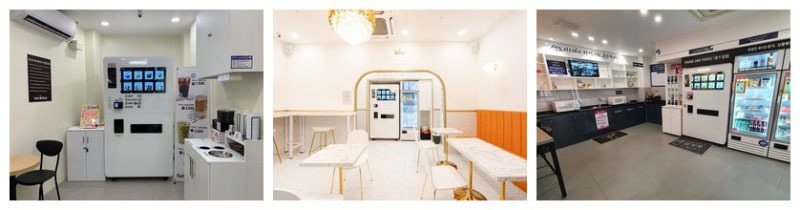
Some customers like to set up a small shelf next to the machine, placing items such as straws, stirrers, cup sleeves, and packing straps—various complementary accessories—for customers to choose from. Some might think that allowing anyone to help themselves in this way could inadvertently increase costs—wouldn't that be a loss? Actually, it’s not the case at all. First, those who take advantage of small perks are ultimately a minority; overall, people’s integrity is trustworthy. Second, providing customers with all the drink-related accessories they might need ensures that they won’t feel inconvenienced and end up purchasing drinks from other vendors—this is also an excellent way to enhance brand goodwill and build a loyal customer base. Langlicheng offers dedicated service counters specially designed for coffee vending machines. Not only can these counters hold all the necessary drink accessories, but they also boast a stylish and elegant design that makes them an attractive addition when placed alongside the coffee vending machine, drawing more customers in.

To do a good job, one must first sharpen one’s tools. The right way to operate a coffee vending machine is to fully understand and master its usage, operation, and maintenance procedures.
Key words:
Previous:
Related News

Contact Us
E-Mail:
WhatsApp:
+86-19003240869
Tel:
Mobile:
Address:
2nd Floor, Building 2, Zone B, Fangyi Science and Technology Industrial Park, No. 222 Xing'an Street, Shijiazhuang High tech Zone, Hebei Province

Free Consultation

Public Account